The Eric Ericson Years
In 1951, Eric Ericson became OD’s new conductor.
Ericson would become the defining figure of Swedish choral music throughout the second half of the twentieth century and played a central role in what became known internationally as the Swedish Choral Miracle. Under his leadership, including a landmark six-week tour of the United States in 1970, OD was consolidated and elevated to entirely new artistic heights.
In 1962, OD introduced Caprice, an innovative concert format that blends humour with serious music and features surprise guest artists. The concept reflected the choir’s original spirit of singing for enjoyment while becoming an immediate audience success. Caprice also significantly strengthened the choir’s financial stability.
Improved finances during the 1960s and 1970s enabled OD to begin commissioning new works for male choir—a tradition that continues today. Deputy conductor Robert Sund also travelled extensively throughout Eastern Europe, uncovering remarkable repertoire in archives, libraries, and antiquarian bookshops. These discoveries helped build what is today the world’s largest library dedicated to male choral music.
Robert Sund and a New International Era
Eric Ericson stepped down in 1991, ending an extraordinary 40-year tenure—surpassing even Hugo Alfvén’s record.
Robert Sund, who had shared the artistic leadership with Ericson since 1985, continued to lead OD through an exceptionally active period of concerts, international tours, recordings, and television appearances. His international reputation opened new opportunities, and OD increasingly collaborated with leading orchestras, including a celebrated performance at the Royal Albert Hall with the Gothenburg Symphony Orchestra in 1997.
Other memorable moments from the 1990s include OD’s surprise appearance disguised as singing waiters during the 1993 Nobel Banquet, and the music video for The Singing Apes, which aired on MTV.
Like several of his predecessors, Robert Sund also contributed original compositions and arrangements, many of which remain an important part of OD’s repertoire today.
A New Chapter with Cecilia Rydinger Alin
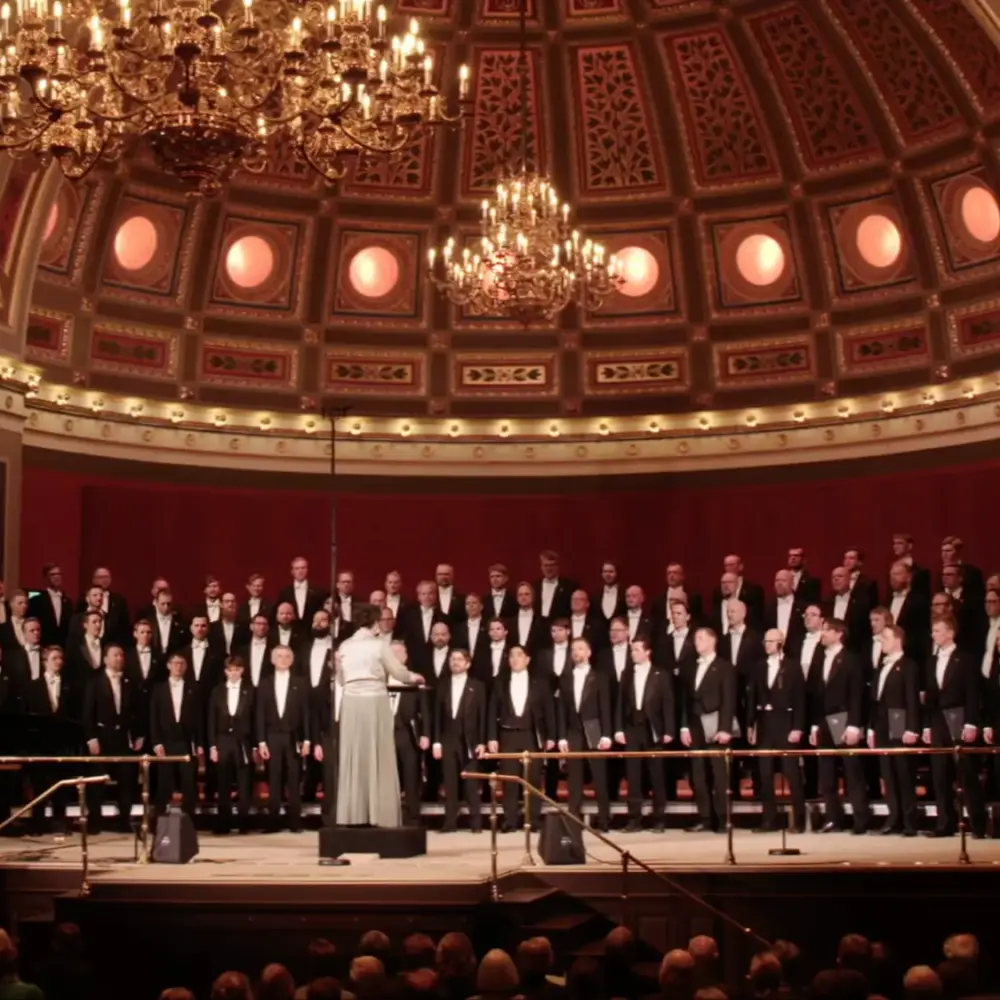
In 2008, Robert Sund concluded 23 years as conductor—and an extraordinary 43 years as a member of OD. He was succeeded by Cecilia Rydinger Alin, whose distinguished career, leading role in Swedish musical life, and deep connection to Uppsala’s choral tradition made her a natural choice.
Under her leadership, OD has continued to expand its concert activities, explore new repertoire, and collaborate with internationally renowned soloists, ensembles, and guest conductors. Together with vocal coach Lars Johansson Brissman and deputy conductor Folke Alin, she preserves the choir’s rich heritage while continually refining its unique sound and artistic expression.
Demand for OD remains high, both in Sweden and internationally. Among recent highlights, the choir appears on two tracks from Peter Gabriel’s 2023 album and was invited to perform Shostakovich’s Symphony No. 13, Babi Yar in Japan in 2024.